

You've got a stain on a ceiling or a few shingles that came off in a windstorm, and now you're stuck on roof repair vs replacement. Most guides you'll find answer that with a generic checklist written for a national audience that never chases a February ice dam. Out here the decision turns on something more specific: where the water is actually getting in. We've roofed the Chippewa Valley since 1993, and Stephen Bonander has been reading these roofs for 33 years, so before we ever quote a fix we get up there and trace the leak to its source. Here's the honest framework we use, the same one that decides whether your roof needs a patch or a tear-off.
Roof repair vs replacement: the question is where the water gets in
A roof leak doesn't automatically mean you need a new roof, and it doesn't mean a quick patch will hold either. The right answer comes from finding where water is actually getting in, and across the Chippewa Valley three sources account for most of the leaks we chase. Sort your problem into one of these three and the repair-vs-replace decision gets a lot clearer.
| Leak source | What it looks like | Usual call |
|---|---|---|
| Ice-dam leak | Ceiling stains near the eaves in late winter, worst after a thaw | Often repair; fix ventilation and the ice-dam path |
| Flashing failure | Leaks around chimneys, valleys, skylights, vent pipes | Usually repair; reseal or replace the flashing |
| Decking rot | Soft, spongy sheathing under the shingles; sagging roof plane | Repair if isolated, replacement if widespread |
Ice-dam leaks are the most common by far in this climate. When attic heat melts snow that refreezes at the cold eave, water backs up under the shingles and finds its way through, usually showing up as ceiling stains in late winter. Those same ice dams are why we so often look at the ice-dam and gutter issues behind roof leaks at the same time, because a roof and its drainage fail together out here more often than people expect.
Flashing failures are next. The metal that seals chimneys, valleys, skylights, and vent pipes is where leaks start far more often than the open shingle field, and failed flashing is frequently a repair rather than a full replacement. Decking rot is the serious one. When water has been getting in for a while, the plywood or board sheathing underneath goes soft, and once it's compromised over any real area, patching the surface won't hold because there's nothing solid left to fasten to.
When to replace vs repair a roof: the framework we actually use
Here's the part the national explainers skip, and it's the whole reason we get on the roof before quoting. A stain over your bedroom often traces to a flashing joint that failed six feet away, because water travels along the decking before it drips. Tearing off shingles directly above the stain and hoping is exactly how a leak gets patched twice and still comes back. Find the source first, then decide.
"Two other contractors gave a homeowner in Altoona vague answers about a leak over the master bedroom. We found the source in about 20 minutes. It's not magic, it's knowing that water runs downhill along the deck before it ever reaches the drywall."
Repair beats replacement when all three of these are true:
- The shingles still have years of service life left and aren't losing granules across the field.
- The leak traces to an isolated failure, a single flashing joint, a few wind-lifted shingles, one bad valley.
- The decking under the problem area is still solid when we open it up.
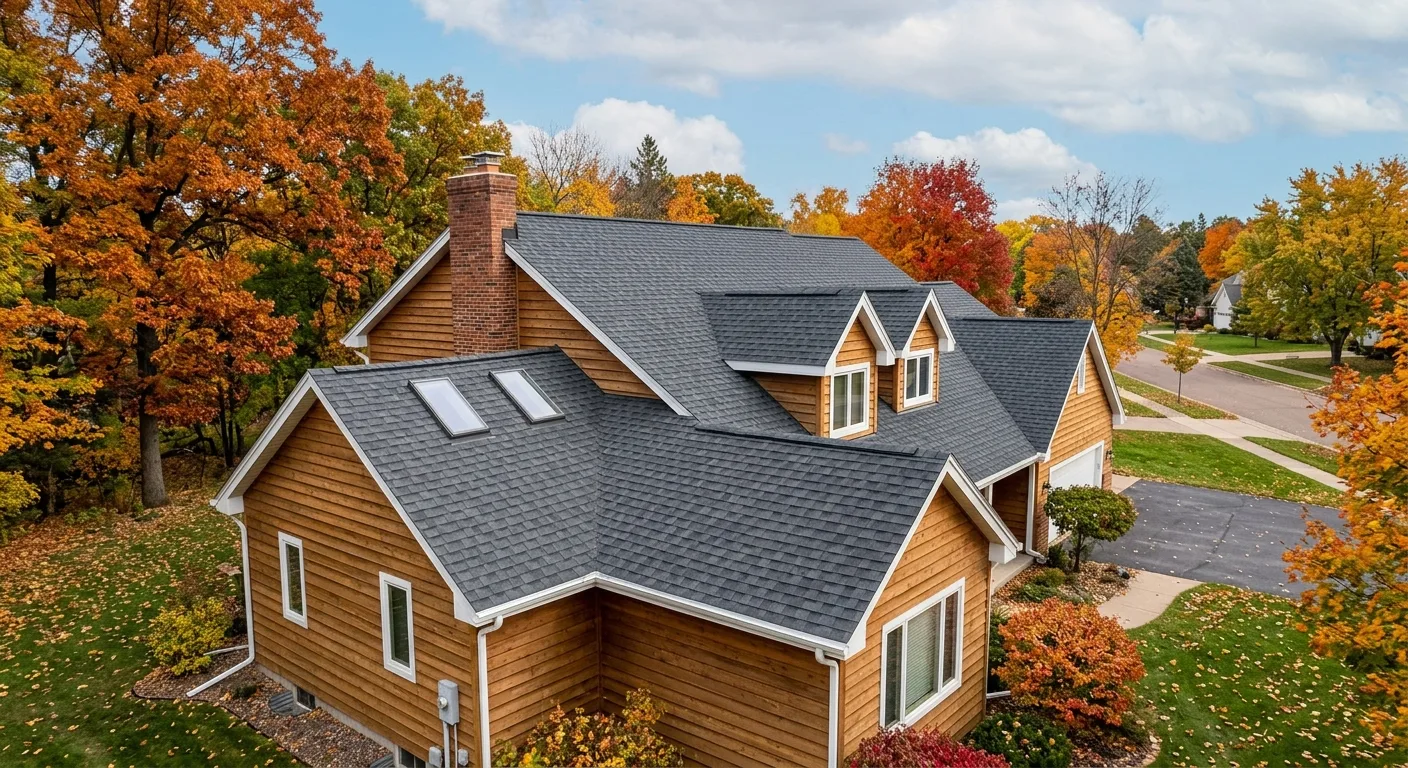
Replacement is the right call when:
- The shingles are original and 20-plus years old, or granule loss is widespread across the roof.
- You're seeing leaks in more than one place, which points to a system at the end of its life rather than one isolated failure.
- The decking has failed over a significant area. Rotted decking gets replaced before any new material goes on, so if the sheathing is soft across a wide stretch, a targeted patch stops making sense.
The math matters too. When shingles are near the end of their life, a series of repairs over the next decade usually costs more than doing the roof once, correctly. We don't push the larger invoice by default. If a targeted repair is genuinely the right call for your roof, that's what we'll tell you. Call (715) 894-1120 and we'll trace the leak before we quote anything.
How we make the call on your specific roof
We come out, get on the roof, and tell you what we see. No vague reports, no pressure. The inspection follows the same order every time: find the water's entry point, check whether the failure is isolated or systemic, and probe the decking under the problem area for softness. Only then do we talk repair or replacement. That sequence is why homeowners from Elk Mound to Menomonie have called us back for their roof, then their gutters, then their windows over the years. When the honest answer is a repair, we say so.
Not sure it's a leak yet? Don't wait for the drip.
Missing or curling shingles, dark staining on interior ceilings, shingle granules washing down into the gutters, and daylight visible in the attic are all signs that waiting is the wrong call. You don't need an active leak to schedule a look. Ice dams force water under shingles in ways that don't surface until spring, and by then the damage is already done. A quick inspection now is cheaper than emergency work in February. Tell us what's going on and we'll come look.
Frequently asked questions
How long does an asphalt shingle roof last?
A standard 3-tab asphalt shingle roof typically lasts 15 to 20 years in Wisconsin conditions. Architectural, or dimensional, shingles run 25 to 30 years under normal circumstances. The freeze-thaw cycling here matters more than most people realize: western Wisconsin roofs cross above and below freezing dozens of times each winter, and that repeated expansion and contraction cracks the edges and valleys faster than a milder climate would. Attic ventilation is one of the biggest factors in longevity. A poorly vented attic shortens any roof's life no matter what material is on it, which is why we check ventilation as part of the roof, not as an upsell.
Is roof shingle wind damage a repair or a replacement?
Wind damage is usually a repair, not a replacement, as long as it's isolated. A few tabs lifted or torn off in a March windstorm come off as a targeted fix, especially on the exposed, open-country lots around Fall Creek and Elk Mound where there's nothing upwind to break the gusts. It tips toward replacement when the damage is widespread, when the shingles were already near the end of their life and brittle, or when we open up the surface and find the decking underneath has gone soft. Standard 3-tab shingles carry a wind rating around 60 mph and architectural shingles commonly run 110 to 130 mph, so on an exposed roof the material already on your home is part of whether one windstorm becomes a pattern.
Get a straight answer for your roof
The only honest way to settle roof repair vs replacement is to find where the water is actually getting in, then look at the shingles' age and the decking underneath. That's what we do before we quote a dollar, and it's free. Learn more about our roof repair and replacement in western Wisconsin, then call (715) 894-1120 or request a roofing estimate. We'll tell you which fix your roof actually needs, not just the one that produces the bigger invoice.